
NOTES
The Industrial Revolution for Cognitive Labor
AI Across Industries
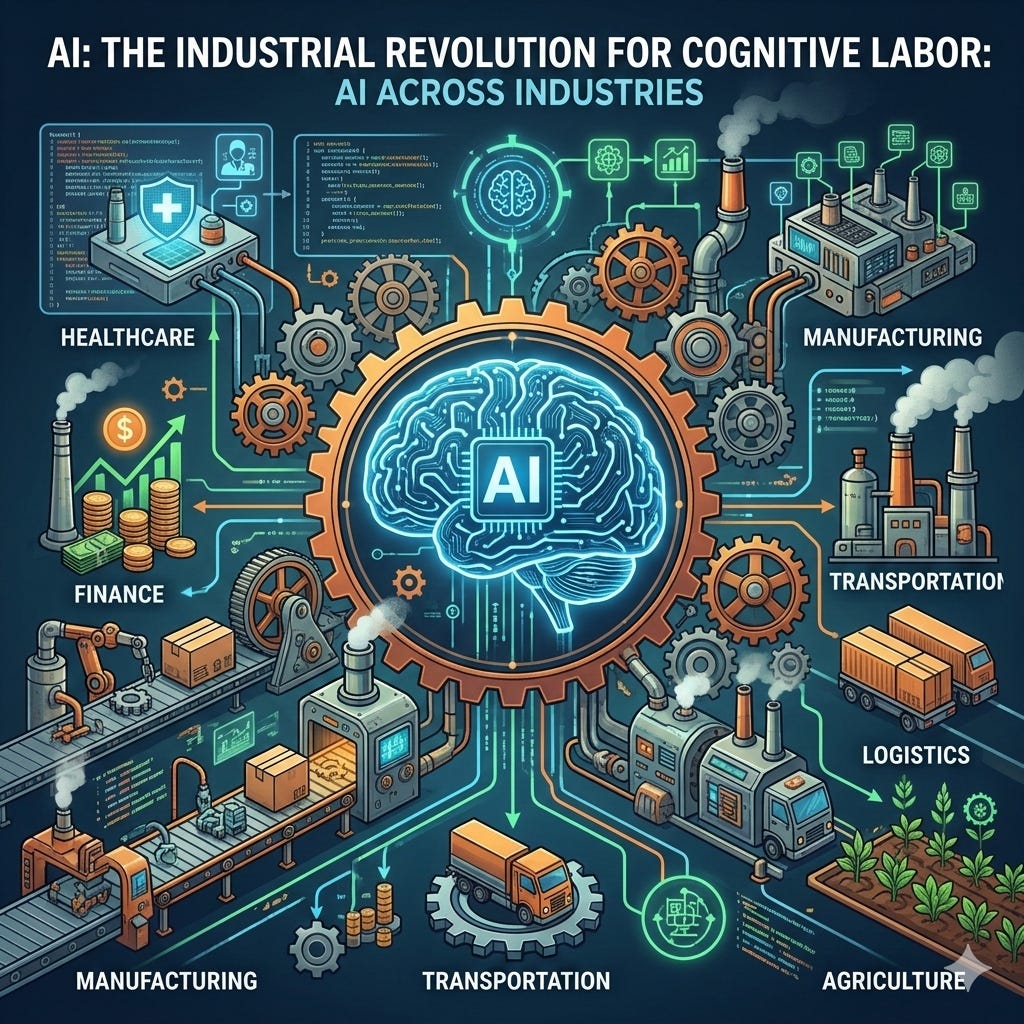
I. The New Industrial Revolution
When people hear the term “AI” the conversation often becomes abstract or exaggerated.
But there is a much simpler way to think about what is happening.
The Industrial Revolution introduced machines that dramatically increased the amount of physical work humans could do. Steam engines, power looms, and assembly lines didn’t eliminate human labor - they multiplied it.
A single worker operating machinery could produce far more than a worker relying on manual effort alone.
AI is beginning to play a similar role, but in a different domain.
Instead of amplifying physical labor, AI amplifies cognitive labor - tasks that involve reading, writing, analyzing information, recognizing patterns, and making decisions.
To understand how this works in practice, it helps to look at how AI is being used across several industries, including:
- Software development and coding
- Writing, publishing, and content production
- Video and media production
- Business consulting and enterprise analysis
- Finance and risk management
- Education and personalized learning
- Music and creative production
- Healthcare Industry
- Legal Industry
II. Software Development & Coding: Ground Zero of the Revolution
The sector where AI’s impact is most measurable and immediate.
Key Points:
- 97% adoption: 76.6% of organizations actively use AI in development workflows, another 20.4% are evaluating — only 3.1% remain disengaged (Futurum Research, 2026 Survey)
- 92% daily usage: 92% of US developers use AI coding tools daily; 82% globally on a weekly basis (Hashnode, Feb 2026)
- 46% of new code is AI-generated according to GitHub; among Y Combinator’s Winter 2025 cohort, 21% of startups have codebases that are 91%+ AI-generated (Hashnode)
- Google reports 25% of its code is already AI-assisted (Hashnode)
“Vibe Coding” — The New Paradigm:
- Intent-driven development: developers describe what they want in natural language, and AI agents build it with terminal access, browser control, and deployment capabilities (YouTube)
- 62% of organizations experimenting with autonomous coding agents (YouTube)
- The freelancer superpower: one person can now build a SaaS product that previously required a team of five (AI Tech Boss)
The Tension:
- Code churn up 41%; code duplication increased 4x; developer trust in AI code accuracy dropped from 43% (2024) to 33% (2026) — yet usage keeps climbing (Hashnode)
- METR’s randomized controlled trial found developers using AI were actually 19% slower at completing tasks — but still believed they were 20% faster (Hashnode)
- IBM reports 60% reduction in development time for internal enterprise apps (Hashnode)
- Entry-level developer hiring plummeted ~50% between 2023 and 2025 (YouTube)
III. Publishing & Book Authorship: The Content Flood
AI has turned book publishing from a craft measured in years to a volume game measured in days.
Key Points:
- Amazon’s Kindle Direct Publishing processes ~1.4 million self-published titles annually; Amazon had to cap uploads at 3 books per author per day in September 2024 to curb AI-generated flooding (The New Publishing Standard)
- Even at 3/day, that’s 1,095 books per year per account — a volume physically impossible for a human author (Reddit discussion)
- Draft2Digital reported publishing volumes trending ~50% higher than usual in 2024 (The New Publishing Standard)
- 53% of publishing companies are using AI, up from 23% in 2022 (Publishers Weekly, via Authors A.I.)
How Real Authors Are Using AI:
- BookBub’s May 2025 survey of 1,200+ authors: ~45% currently using AI (Authors A.I.)
- Top use cases: research (81%), marketing copy (73%), outlining/plotting (72%), editing (70%) (Authors A.I.)
- 74% of authors who use AI don’t disclose that fact to readers (Authors A.I.)
The Dark Side:
- AI-generated imitations and summaries of real authors’ books flooding Amazon — researcher Melanie Mitchell found an AI-generated clone of her own book for sale (WIRED)
- AI pioneer Fei-Fei Li’s memoir spawned over a dozen AI-generated “summaries” on Amazon (WIRED)
- Amazon’s “Ask This Book” Kindle feature drew pushback from the Authors Guild, who called it an unlicensed AI enhancement that “sets a dangerous precedent” (Writer Beware)
- Local authors in Boston reported copycat AI books appearing on Amazon within days of their legitimate publications (Boston 25 News)
IV. Video Creation & Editing: The Democratization of Cinema
Professional video production — once requiring teams of editors, colorists, and VFX artists — is becoming a prompt-and-refine workflow.
The AI Video Landscape in 2026:
- Text-to-video: Sora 2 Pro (OpenAI), Veo 3.1 (Google), Runway Gen-4.5 — each with distinct strengths in cinematic storytelling, photorealism, and commercial-grade aesthetics (IPFoxy, Feb 2026)
- Image-to-video: Feed a static image into Runway or Pika Labs and animate it with motion, physics, and camera work (YouTube comparison)
- Sora supports up to 1080p, ~60 seconds, with sustained narrative continuity — it’s currently the only model capable of this (IPFoxy)
AI-Powered Editing:
- AI tools can now auto-identify key scenes, create rough cuts, add captions, perform color correction, balance audio, suggest background music, and generate highlight reels (Think Branded Media)
- ~40% of video editors expected to utilize AI-driven tools for tasks like color grading and audio enhancement (Glean)
- Healthcare organizations using AI to rapidly produce multilingual patient education videos and training content (Think Branded Media)
The Creator Economy Impact:
- Entire “faceless YouTube channels” are being built using AI tools — no camera, no on-screen talent required (Artsyl, Feb 2026)
- Multi-tool AI video workflows now allow a single creator to go from concept to finished product using Sora for wide shots, Veo for detail shots, and traditional NLE software for final assembly (YouTube workflow guide)
V. Management Consulting: McKinsey’s 25,000 AI Agents
The quintessential knowledge work industry is being restructured from within.
McKinsey’s Digital Workforce:
- McKinsey CEO Bob Sternfels announced in early 2026 that the firm now operates with 35,000 human consultants plus 25,000 AI agents — with a goal of one AI agent paired with every human employee (YouTube)
- Lilli, McKinsey’s proprietary GenAI platform, is used by 72% of its professionals, generating 500,000+ prompts monthly and saving ~1.5 million hours of work in 2025 (Whitehat SEO)
- QuantumBlack, McKinsey’s AI arm, has 7,000+ technologists across 50 countries and drives ~40% of the firm’s client work (Business Insider)
- An AI agent called “Tone of Voice” now handles the writing-style review that consultants used to do manually (Business Insider)
Across the Industry:
- BCG built “Deckster” to reduce time consultants spend polishing PowerPoint slides; 60% of companies using GenAI already have active “Deploy” plays (Business Insider / Articsledge)
- Deloitte invested billions in AI; launched “Zora AI” — agents trained in specific subjects like finance or marketing, designed to “think like humans”; also launched “Sidekick,” their internal ChatGPT alternative (Business Insider)
- KPMG signed an agreement with Google Cloud for Agentspace licenses for its entire US workforce (Business Insider)
- The global AI consulting market: $11 billion in 2025, projected to $90.99 billion by 2035 (26.2% CAGR) (Articsledge)
- 77% of UK consulting firms have integrated AI into their systems (MCA Member Survey, Jan 2026, via Whitehat SEO)
- ~150 former consultants from McKinsey, Bain, and BCG were contracted to train AI models to perform entry-level consulting tasks (Bloomberg, via Whitehat SEO)
The Structural Shift:
- AI is destroying the traditional consulting pyramid model: junior analyst tasks are being automated, freeing expensive senior consultants for high-level strategic counsel and stakeholder management (YouTube)
VI. Financial Services: Wall Street’s Billion-Dollar AI Bet
Banks are pouring tens of billions into AI, reshaping everything from junior analyst work to client-facing tools.
The Investment Scale:
- JPMorgan: ~$18 billion annual technology budget; CEO Jamie Dimon said AI “may reduce certain job categories or roles,” comparing its impact to the printing press and electricity (Business Insider / Fortune)
- Bank of America: ~$13 billion on tech in 2025, planning 10% more in 2026; virtual assistant Erica handled 2 million customer interactions in a single day, answering 700 types of questions (up from 210) (Business Insider)
- Citigroup: AI tools available to 182,000 employees in 84 countries, 70%+ adoption; GenAI tools saved 100,000 developer hours per week with automated code reviews (Business Insider)
- Goldman Sachs: Internal memo stated AI will “drive efficiency, slow hiring, and result in a ‘limited reduction’ of roles” (Business Insider)
The Nuance:
- Citigroup research found 54% of financial jobs “have a high potential for automation” — more than any other sector (Fortune)
- Yet current layoffs are largely attributed to pandemic-era overhiring and economic uncertainty, not AI directly (Fortune)
- AI tools performing “hours’ worth of junior-level analyst tasks in just seconds” — one tool called “Socrates” at an unnamed bank (Fortune)
- Morgan Stanley sees investors beginning to rotate from AI “builders” (infrastructure providers) to AI “adopters” (companies using AI to lift productivity and margins) (Morgan Stanley)
VII. Education: Alpha School and the Two-Hour School Day
AI is challenging the most fundamental assumption of education: that learning requires six hours of classroom instruction per day.
Alpha School’s Model:
- Founded in Austin, TX in 2014; now in NYC and expanding to California; tuition up to $65,000/year (NY Post, Jan 2026)
- Students complete all core academics (language, math, science, history) in just 2 hours per day on tablets/laptops, with AI-driven personalized learning paths (NY Post)
- No traditional teachers — human “guides” monitor classrooms; no homework (NY Post)
- Students score in the top 1-2% nationally on MAP Growth testing, achieving ~2.3x annual growth compared to peers (Alpha School)
- A student completes a full grade level in ~20-30 hours of focused study — roughly 10x faster than traditional pacing (Alpha School)
How It Works:
- AI algorithm generates personalized question sets; students must achieve 90%+ mastery before advancing (Alpha School)
- Based on Benjamin Bloom’s 1984 “2 Sigma Problem” — one-on-one mastery tutoring can raise an average student to 98th-percentile performance; Alpha applies this digitally (Alpha School)
- AI tailors content to make learning engaging — e.g., teaching math through Taylor Swift album sales instead of baseball statistics (NY Post)
- Rest of the day spent on “life skill workshops”: rock climbing, building IKEA furniture, Rubik’s Cubes, entrepreneurship, athletics, public speaking (NY Post)
- Long-term goal: scale the TimeBack platform globally via a sub-$1,000 tablet capable of offline AI tutoring (Alpha School)
VIII. Music: Suno and the Spotify-Every-Two-Weeks Machine
AI is generating the equivalent of Spotify’s entire catalog every two weeks.
Suno’s Explosive Growth:
- 2 million+ paying subscribers, 100 million+ total users, $300 million in annual revenue (Forbes, Feb 2026)
- Users produce ~7 million songs per day — equivalent to Spotify’s entire catalog every two weeks (Billboard, via Forbes)
- Raised $250 million from Menlo Ventures and NVentures at a $2.45 billion valuation (Forbes)
- Producer Timbaland partnered with Suno, claiming he “probably made a thousand beats in three months” and calling it a tool presented by God (Forbes)
Industry Impact:
- AI-generated personas are charting: Xania Monet (AI persona of songwriter Telisha “Nikki”) topped Billboard R&B song sales; Breaking Rust (AI-generated country act) charted on Billboard with 20M Spotify streams (Forbes)
- Major record labels sued Suno and Udio for allegedly exploiting recorded works (AP News, Feb 2026)
- “Say No to Suno” campaign launched by artist rights organizations (Forbes)
- No musical talent, practice, or instrument required — users input descriptive terms and a captivating rhythm emerges (AP News)
IX. Healthcare: From Administrative Burden to Clinical Intelligence
AI is reclaiming thousands of nursing hours and transforming care delivery.
Key Developments:
- 80%+ of health systems prioritizing agentic AI for clinical operations, care delivery, and revenue cycle management (Deloitte Insights, Feb 2026)
- Sentara Health deployed agentic AI for virtual nursing — ambient documentation, remote consultation, care management — reclaiming thousands of nursing hours within months (Deloitte Insights)
- Mayo Clinic deploying AI agents for eligibility verification, prior authorization, claims processing, and prescription support (Deloitte Insights)
- AI transforming clinical documentation from static, retrospective records to dynamic, proactive, predictive tools (Deloitte Insights)
- Concern: Commercial insurers using AI to determine claims and prior authorizations, potentially targeting financial gain over medical necessity (U.S. Senate Subcommittee report, via AHA)
X. Legal Industry: From Billable Hours to AI-Augmented Judgment
AI is handling drafting, research, and regulatory recall — the differentiator for legal leaders is now human judgment.
Key Points:
- As AI increasingly handles drafting, research, and regulatory recall, the true differentiator for legal leaders is human judgment, strategic partnership, and business insight (DSG Global, Jan 2026)
- State legislatures actively pursuing AI regulation in healthcare, with Colorado proposing some of the most stringent AI disclosure requirements (Healthcare Law Insights)
- Legal industry grappling with copyright, IP, and licensing questions raised by AI tools across all sectors
XI. The Labor Market Meta-Analysis: Who Wins, Who Loses
Connecting the threads across all industries.
The Entry-Level Crisis:
- Dallas Fed: Employment has declined 1% since late 2022 in the 10% of sectors most exposed to AI; the decline falls disproportionately on workers under 25 (Dallas Fed)
- Stanford researchers confirm the decline in AI-exposed employment is particularly pronounced for those under 25 — not from layoffs, but from a low job-finding rate for new graduates (Dallas Fed)
- Computer systems design and related services sector employment has declined 5% since ChatGPT’s release (Dallas Fed)
The Experience Premium:
- Wages are rising in AI-exposed occupations that value tacit (experiential) knowledge; wages are declining in AI-exposed occupations with low experience premiums (Dallas Fed)
- Senior developers with 10+ years experience report 81% productivity gains from AI; junior developers show mixed results because they lack judgment to evaluate AI output (Hashnode)
- The traditional model of career progression — entry-level codifiable tasks → gradual acquisition of tacit knowledge → senior expertise — is being disrupted because AI is eliminating the bottom rung of the ladder (Dallas Fed)
The Gartner Prediction:
- Share of development team members from nontraditional software engineering backgrounds predicted to rise from 20% (2025) to 40% by 2028 (Itransition)
XII. Conclusion: Navigating the Revolution
Key Takeaways:
- This is not speculation — it’s happening now. 97% of software organizations, 77% of UK consulting firms, 88% of organizations globally are already using AI in at least one business function.
- The pattern is consistent across industries: AI automates codifiable tasks and augments experienced judgment. The entry-level knowledge worker is the most at risk.
- Volume is exploding everywhere: 7 million songs/day on Suno. 1,095 books/year per Amazon account. 46% of new code is AI-generated. McKinsey’s 25,000 AI agents saved 1.5 million hours.
- Quality and trust lag behind adoption. Developer trust in AI code dropped to 33%. Authors don’t disclose AI use (74%). AI-generated book clones and music lawsuits proliferate.
- The revolution creates new roles and destroys old ones — just like the original Industrial Revolution. The question is not whether AI will transform cognitive labor, but how fast societies can adapt.
Call to Action:
- For workers: Cultivate tacit knowledge and judgment — the things AI cannot replicate and learn to use AI as a force multiplier
- For leaders: Invest in AI literacy across the organization while preserving the human expertise pipeline
- For policymakers: Address the entry-level employment crisis before it becomes a generational problem
- For everyone: Understand that we are living through a once-in-centuries transformation — and act accordingly