
NOTES
Stop Competing For A Job - Demand Attention From Employers
...By Designing Your Own Hiring Interface with AI
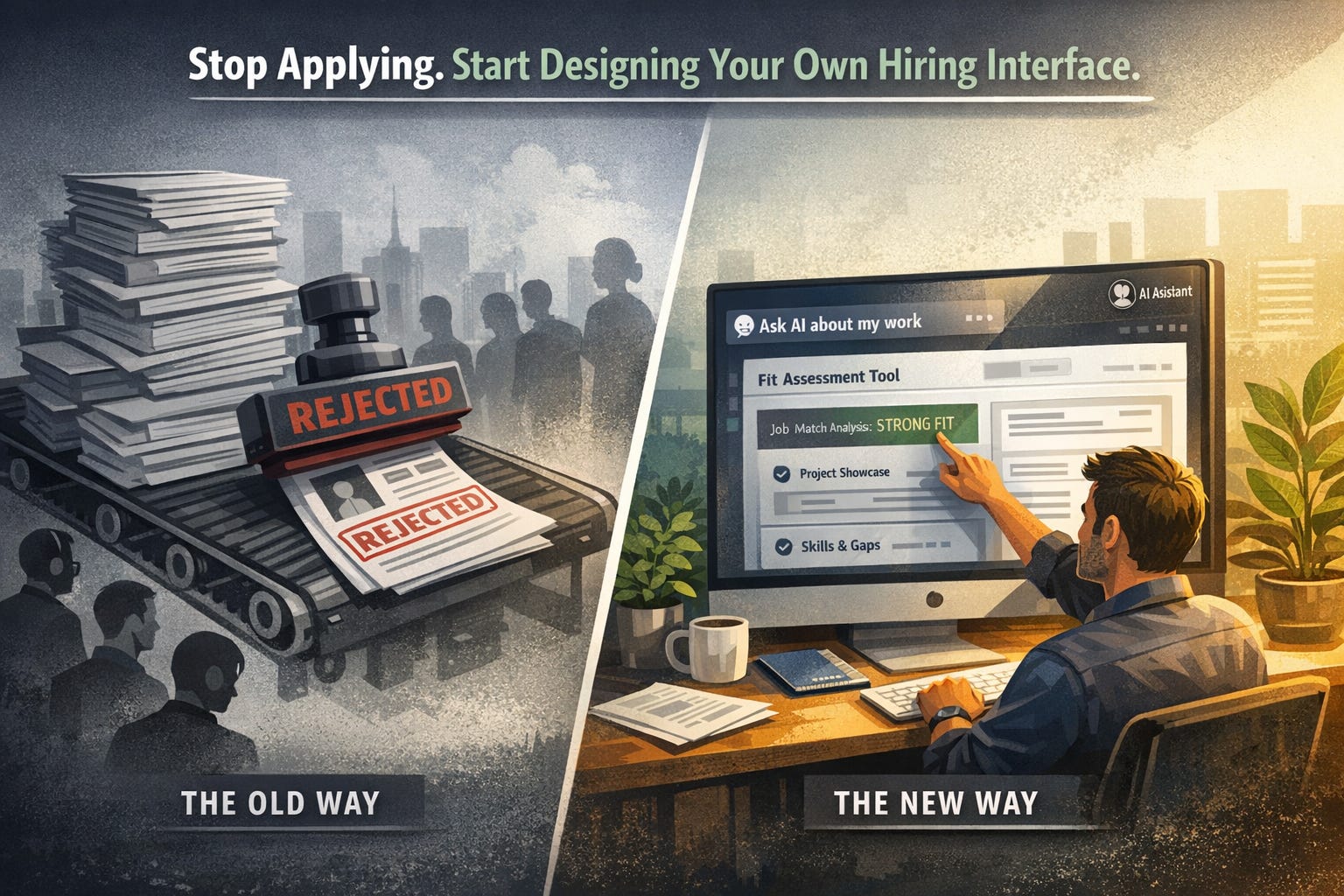
For those searching for a full-time job, it’s very apparent that the effectiveness of platforms like LinkedIn has collapsed. Not because hiring has slowed (which it has), but because attention has waned. The volume is still there. The infrastructure is still there. What’s gone is the ability to be noticed - or worse, the ability to be evaluated meaningfully.
In response, most people do the obvious thing: optimize harder for the same broken hiring system. Better keywords. Cleaner resumes. More tailoring. More applications. Unfortunately, this is an arms race where both sides escalate and everyone loses. More flailing wildly for potential employees and more noise that potential employers need to sift through.
It’s time for potential candidates to step out of the pile entirely by creating their own service that employers can use.
Demonstrate your capabilities by creating your own hiring interface on your personal website
Instead of sending static documents into black holes, candidates should integrate AI chat interfaces on their personal site. These interactive portfolios will invite employers to investigate rather than filter. Think less of a “resume” and more of an online experience and service.
An AI-powered personal site can:
- Answer nuanced questions about your work in real time
- Reference real artifacts - documents, diagrams, dashboards, other websites, code
- Explain tradeoffs, constraints, and lessons learned
- Admit limitations without becoming defensive
Invert the power dynamic
An AI-powered personal site has the added benefit of inverting the hiring power dynamic. The traditional hiring process puts candidates in a supplicant posture.
A candidate-controlled interface flips this. You’re no longer just presenting yourself for evaluation - you’re evaluating whether an organization is a fit for you as well.
Here’s a powerful feature that you could build into your personal website: We’ll call it an AI-powered fit-assessment tool.
Imagine a simple interface where a hiring manager pastes a job description and gets back an honest analysis. Where you match. Where you don’t. Why. With links to evidence. And - critically - the AI tool would have an explicit willingness to say no to misaligned roles.
This signals something rare: judgment.
Publishing strengths, moderate competencies, and known gaps doesn’t weaken your position. It strengthens it. It saves time. It builds trust. It tells the potential employer that your time has value too.
That confidence alone differentiates you from 99% of applicants.
The psychology of drawing employers to you
If someone is presented with a standard resume, they’re in filtering mode immediately. Defensive. Pattern-matching. Looking for reasons to say no.
If someone arrives at a thoughtfully designed interface - clean aesthetics, clear navigation, interactive depth - they shift into investigative mode. Curiosity replaces suspicion. And curiosity drives attention and discovery.
People trust conclusions they reach themselves more than claims presented to them.
Your job isn’t to convince. It’s to architect discovery - to guide inquiry ethically, so potential employers uncover the truth of your capability through interaction.
Of course making people aware of your hiring interface is still a problem that needs to be addressed. But first, design an experience that’s actually worth exploring. Then worry about how people arrive there.
Designing your hiring interface: utility beats novelty
This isn’t about gimmicks. Flashy demos without substance collapse fast. What lasts is utility.
A candidate interface that genuinely saves a hiring manager time - by clarifying fit, surfacing evidence, and answering real questions - creates goodwill. It turns differentiation into service.
The same AI that broke hiring makes this possible. Low-cost AI infrastructure lets you prototype these systems in hours, not weeks. The constraint is no longer tooling or development expertise. It’s thoughtfulness.
Guidance for early-career candidates: different emphasis, same principle
An AI agent on your personal site will work best when you have real material to stand on. Early-career candidates shouldn’t fake that.
Instead, narrative portfolios win: projects, learning velocity, decision journals, documented growth. Show how you think. Show how you learn. Show what you’re becoming.
The principle holds: don’t assert - demonstrate.
Final Takeaway For Candidates
Break out of the supplicant role; instead build AI interfaces that prove substance and command attention instead.
Final Takeaway For Employers
Stop skimming claims - design your hiring process to reward candidates who let you interrogate real work, real judgment, and real limits.