
NOTES
AI Shouldn't Necessarily Be Your Go-To Solution for Business Problems
...Unless it makes sense...
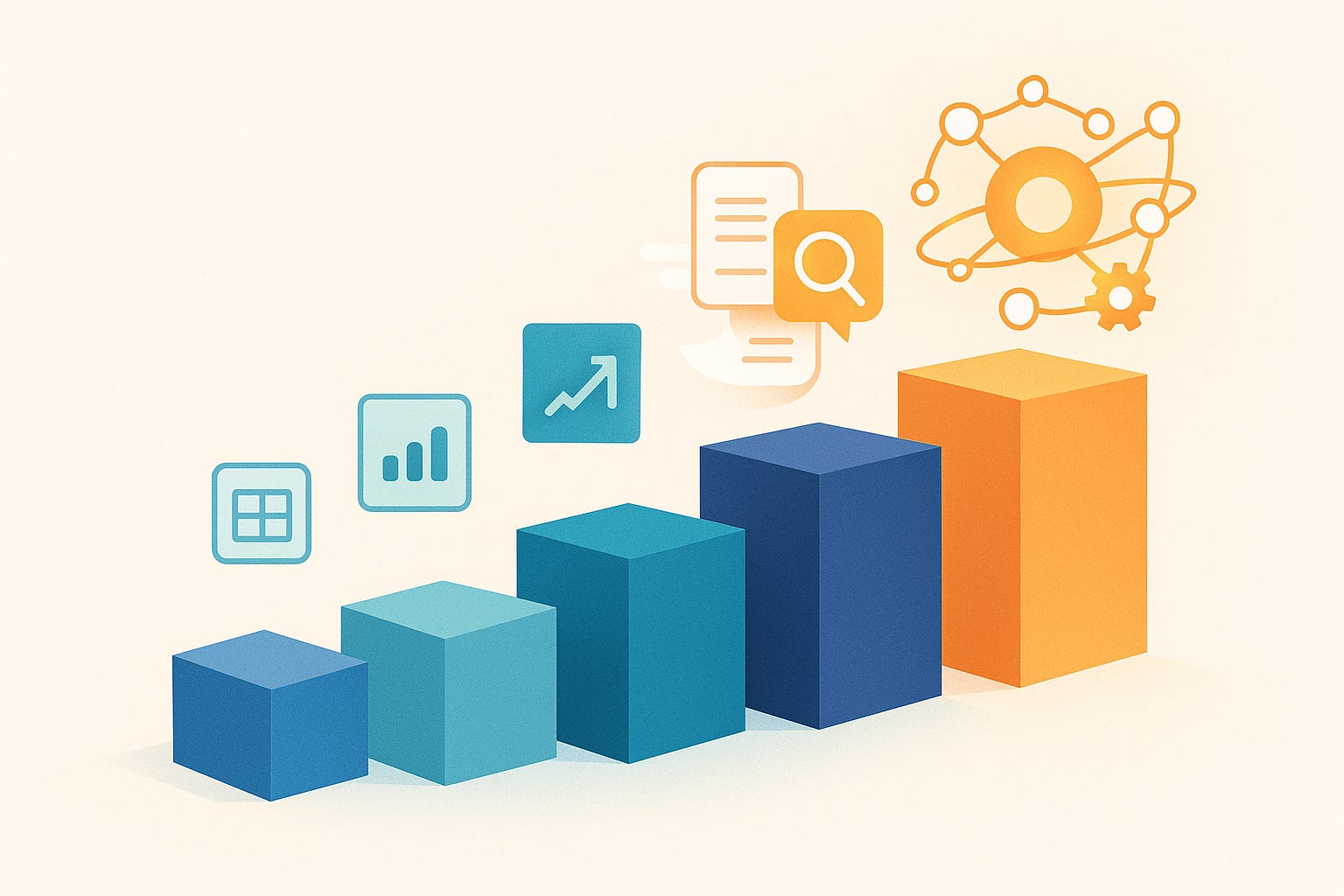
Most “AI projects” aren’t AI problems. They’re reporting, prediction, content, or workflow problems. Pick the simplest tool that gets the job done, and only climb in complexity if the numbers demand it.
The Ladder (Ratchet Up Solutions In This Order)
1) Same input → same output? Deterministic Data Processing
When to use: Rules, sums, joins, filters, repeatable reports—no ambiguity.
Examples
- Monthly revenue by region (dashboard & scheduled PDF).
- Top overdue invoices by amount + age (daily call list via email).
- Inventory reorder list (moving average + lead-time buffer).
- Tech dispatch board merging tickets, SLAs, parts, locations.
Tools: BigQuery / Redshift / Snowflake + Looker Studio / Power BI; Postgres + Metabase; scheduled SQL / Shell / Python.
Time-to-value: Days · Cost: $ (lowest) · Maintenance: Low
2) One thing to predict from rows? Classical Machine Learning (Tabular)
When to use: You have structured data and a single target (yes/no or numeric).
Examples
- Lead scoring: probability to close in 30 days; route top leads.
- Churn/renewal risk: trigger save-playbooks 60–90 days out.
- Late-payment risk: adjust terms/deposits for high-risk invoices.
- Inventory demand forecasting (SKU/store/week): set reorder points by confidence.
Tools: BigQuery ML / Snowflake ML / Redshift ML; Vertex AI / SageMaker / Azure ML; scikit-learn + XGBoost/LightGBM; MLflow for tracking.
Time-to-value: Weeks · Cost: $$ · Maintenance: Moderate (drift monitoring, retrains)
3) Unstructured text/images & flexible output? Generative AI / LLMs
When to use: Summarization, drafting, translation, structured extraction from messy docs.
Examples
- Support → Knowledge Base: turn resolved tickets into how-tos (human still needs to review).
- Proposal/Statement of Work (SoW) first drafts from a short form (PM edits, then send).
- Contract/PO summaries: pull renewal dates, SLAs, penalties with validation.
- Invoice/receipt parsing: extract line items to your system with rule checks.
Tools: Your preferred LLM (OpenAI, Anthropic, Gemini, self-hosted)
Time-to-value: Months · Cost: –$ (tokens + evaluation/iteration) · Maintenance: Higher (adjust AI prompts, implement governance)
4) Ongoing multi-step decisions across tools? Multiple AI Agents (Orchestration)
When to use: Dynamic workflows with clear decision points, retries, fallbacks, and audit.
Examples
- Scheduling + follow-ups: offer slots, book, write back to CRM, nudge no-shows.
- Collections assistant: prioritize invoices, draft reminders, schedule retries, log outcomes, pause on disputes.
- On/Offboarding: create accounts, assign licenses/devices, verify checks, roll back on failure.
- Patch/change runner (IT/MSP): stage waves by risk, execute, verify health, post summaries.
Tools: Agent Frameworks (lots of different combinations but I like n8n + Playwright + Redis + Slack + Temporal), plus software for observability (logs/traces/state), human approvals, circuit breakers, manual override & rollback.
Time-to-value: Longest · Cost: $$$ · Maintenance: Highest (treat like human staff)
Quick Rule of Thumb
- If a report or rule will do it, stop at Data Processing.
- If you’re predicting a single target on rows, use Classical ML.
- If the work is wordy/unstructured, use an LLM with validation.
- If it’s a living workflow, consider an Agent—only with observability.
- If it’s not ≥ 10× better than the simpler rung, don’t escalate.
Takeaway: Ship business value at the lowest rung. Clean data and clear metrics beat fancy tools every time.
Inspired by Nate’s talk on framing data, ML, LLMs, and agents. Video: